Chapter 13: Notes From Capt. V.E. Smythe - 1974
56th Battalion
The following notes in Vern’s writing are from a taped interview that was conducted by Prof. T. H. Liddle, [Senior Lecturer in History, Sunderland Polytechnic, Department of Education, Chester Rd., Sunderland, Co. Durham, England] in 1974.
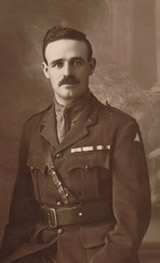
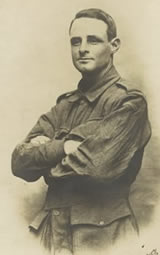
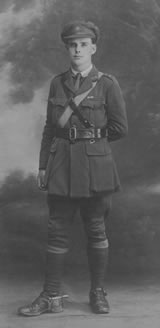
VERNON ERLE SMYTHE
Enlisted 3rd BN, 1st INF BDE, 1st A.I.F. 1st AUSTRALIAN DIVN, 1st AUS EXPEDITIONARY FORCE 1914
Transferred to 4th BN. couple of weeks prior to excavation of GALLIPOLI
Transferred to 56th BN. on formation of 5th DIVN.
ENLISTMENT
August or September 1914 travelled from Narrandera (Riverina N.S.W.) to Sydney to enlist in the 1st Expeditionary Force. A callow unsophisticated youth approaching 20 years old. Could have been accurately described as a “hick from the sticks”.
On enlistment posted to “F” company (battalion at that time comprised 8 companies – A to H). Sleeping amenities for first week or so one Army blanket, one bed being 6 feet portion of one of the concrete steps of grandstand of Randwick racecourse. Some time later we were promoted to tents.
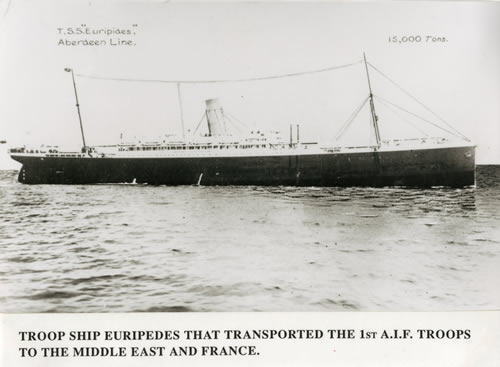
TROOPSHIP “EURIPIDES” - Sydney to Alexandria Egypt
1st Bde. with other bits and pieces embarked on SS EURIPIDES in Sydney towards end 1914. Gathered at Albany West Australia with other companies of Expeditionary Force, thence in three lines abreast under naval escort across Indian Ocean and through RED SEA to Alexandria Egypt. Life aboard EURIPIDES comprised food (adequate) canvas hammocks for sleeping and physical training. In between watched several shrewd Crown & Anchor (card game) boys gathering in as much of our 6 bob a day pay as they could coax out of us.
A few days out from Albany we learned that the cruiser “SYDNEY” had put ‘paid’ to the score of the German cruiser “EMDEN” for which we were duly thankful because if the “EMDEN” had located and penetrated our strung out convoy quite a number of our troopships would undoubtedly have been sunk.
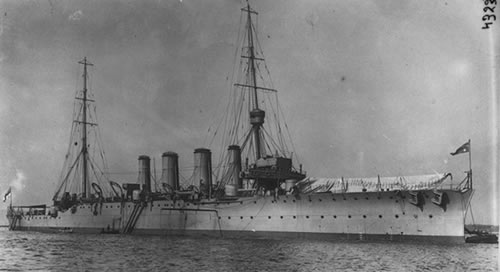 HMAS Sydney
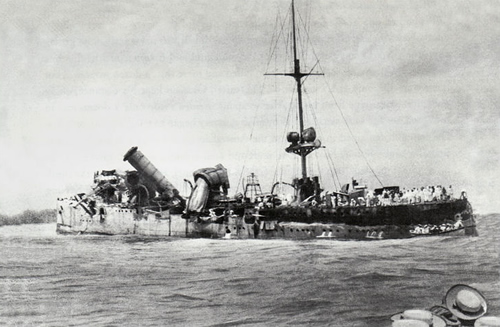 Sinking of the Emden
On arrival at Alexandria most of the Crown & Anchor boys off our ship promptly went AWL with plenty of cash to sample the delights offering in Alex and Cairo. Undoubtedly similar shrewdies from other troopships did likewise.
EGYPT - DESERT TRAINING
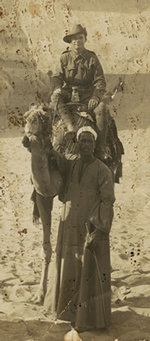 Vern in Egypt
From Alexandria we were transported to a tent camp area about a mile or two from the pyramids. In this area we underwent field training which consisted almost entirely of attacking in open order, over undulating treeless sandhills (into which we sank halfway to boot tops at each step) at a hypothetical enemy a mile or so away. By way of relief from these attacks we did field marches, (full marching order mostly) over the same soft sand. All of which was completely unreal as a preparation for our eventual attempt to take over the Gallipoli peninsula with its deep winding gullies and heights thickly covered with trees and shrubbery on the forward slopes. However our sandhill training toughened us up.
Cairo leave from camp from about 5pm to parade fall-in next morning was reasonable. Some of my tent mates, older men of much experience, delighted in waking me up on their return 3 or 4am to tell “Baby Vernon” of every detail of their evening experiences with ladies of the town.
GALLIPOLI LANDING 25th APRIL 1915
I (now sergeant) and my signal unit were in the second wave landing (about 9am) carried by barges and boats from our troopship to the beach. Set up a signal station on a small hill about half way up the valley subsequently known as Shrapnel Gully. Our Battalion and other troops had penetrated half a mile or so ahead of us and were digging in. Momentum of attack had petered out mainly due to an unexpectedly difficult country causing loss of direction with consequent confusion and uncertainty of and mixture of many units. Not much enemy opposition other than by snipers who from unseen positions in scrub covered country had no difficulty in picking off many of our men.
This was my first “baptism of fire” and I did not like it. That night I was devastatingly frightened that enemy troops would come flooding down on top of me and my section - I fervently wished that I had never left home! Next day we joined up with our Bn. Hqrs. at the top of Shrapnel Gully. Two days later my unit officer was shot and subsequently I was commissioned 2nd Lieut. in charge of the signal section.
MAY 19 TURK ATTACK
I did not see much of the May 19 Turkish attack (brilliantly described in Alan Moorehead’s book “GALLIPOLI”.) I went along to the front line trench (only about 40 yards Bn. Hqrs and my signal station) to have a dekko at the attack but was promptly ordered back by the colonel who said “You get back to your signal station- we’ll cope with the Turks.” Actually I had no desire to cope with the Turks but was keen to have a look–see at what was going on. However I did manage to get a short time look at the Turks during the local armistice on May 24 when they came out of their trenches under a white flag to gather up their dead from the May 19 attack.
ATTACK ON LONE PINE
one or two lines missing from top of photocopy.
... to the Sea of Marmara. In the event we captured the enemy front line and in some sectors their support line and then were bogged down in a stalemate. The Turks trenches, like ours, were deep and included strong points every 20 or 30 yards, made by 12” diameter logs straddling the trench for a distance of 12/15 feet. From cover thus provided the Turks could pick off our attacking troops as they jumped down into the trench. It was in these circumstances that Lt. Jacka won a V.C. by his remarkable feat of bayoneting 6 or 7 Turkish soldiers in one of these strong points.
My battalion was in support of our attack battalion and our colonel was badly worried because there was no communication either by phone or runner with our forward troops. He told me of his anxiety and asked me if I thought I could send a unit of my signal section with a telephone across to the officer in charge of the captured enemy trench. He specified that this was a suggestion, not an order because the likelihood of getting through enemy enfilading fire was extremely remote. However, a signalling unit with a telephone dashed over with the telephone line playing out behind them and got across without casualties. Without ceremony the unit jumped into the captured trench and actually landed on top of the officer in charge of forward troops – 4th Bn. Colonel ! – who was delighted to welcome them and the telephone. Thus was communication established.
I SEE MYSELF SHOT
The Turks held on tightly to their support line, only about 20 yards in front of us and it was here that I saw myself apparently being shot by one of their soldiers. I was scanning the enemy line through a periscope and was interested in examining a snipers post when I saw a rifle muzzle extended through the opening of the protective iron shield of the post. I was slow in the uptake because I did not realise the rifle was actually being aimed at my reflection in the looking glass at the top of my periscope. My ignorance was dispelled when the said looking glass and surrounding tin were shattered by the enemy shot. Fragments of the glass and tin were channelled down the remainder of the periscope into my face. Luckily my eyes escaped damage but bits of glass and metal (too deep for extraction by the Bn. Medical Officer) were working their way to the surface of my face for months and in a few cases, years afterwards.
LIFE ON GALLIPOLI was not unduly unpleasant except that food was uninteresting in the form of bully beef and ¾ inch thick biscuits (Huntley & Palmer). The latter were almost unbreakable but somehow we managed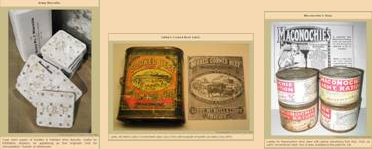 them. Hot strong tea served to wash down the food. Occasionally we had a bacon issue (no eggs of course). A short time before we evacuated the peninsula we began to get issues of MaConochie rations which were a great improvement on bully beef.
Flies were very troublesome at all times but particularly at meal times and especially when bacon was on the menu. It was a work of art and skill to get a mouthful of bacon without taking in a dozen or so flies at the same time. Body lice were an annoying and irritating difficulty which continued with us all through our period on the peninsula.
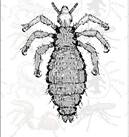 Adult lice are 2-4mm in
length, grey in colour.Delousing stations (subsequently experienced in Belgium and France) were not available to us, and our personal efforts at delousing seemed only to incite the insects to added efforts of bloodsucking and enthusiasm in further procreation. Some relief from these difficulties was obtained from occasional trips to the beach for a swim. For the bulk of our stay on Gallipoli the weather was warm and sunny and food for colour appreciation was provided every afternoon by breathtakingly beautiful sunsets. At about 4 o’clock each afternoon white clouds began to gather behind the Island Samos and later, as the sun lowered, the clouds took on most beautiful colouring which lasted with many variations until the sun hit the horizon in a blaze of red. Almost as amazing as the glory of the sunsets was the way hundreds of hard-bitten soldiers took up vantage points from which to enjoy the wonderful spectacle of the cloud colourings.
HAND GRENADES USED ON GALLIPOLI
The close proximity of our front trenches to those of the Turks led to a lot of grenade throwing. The Turks’ bombs were cast iron spheres (a little smaller than a cricket ball) filled with a fuse of about four seconds and very handy for throwing. Our reply was a jam tin bomb filled with bits of metal and having a 4 second fuse. Not nearly so handy for throwing as was the enemy bomb. 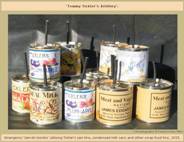
Our protection against the latter was the setting up of bomb smotherers. These were men whose job was to watch for every enemy bomb landing in the trench and then promptly smother it with a folded army blanket. Quite effective because although the explosion lifted the blanket up it, the blanket, efficiently held the pieces of the exploded bomb. Another method (entirely unofficial and frowned on by the “Brass”) was to watch for the enemy bomb coming over the parapet, catch it and sling it back to the Turks. I had seen this done once or twice and felt I would like to do it myself. So one day I held myself at the ready, saw a bomb come over and roll to the bottom of the trench. Did I grab it and throw it back? NO I did not – instead I leaped for the security of the fire bay until the bomb exploded. I think my main reasons for avoiding contact were firstly that I was not as dare-devil as I thought I 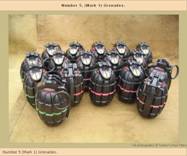 was, and secondly because with smoke and sparks issuing from the very short fuse, the darned bomb looked much too vicious and unfriendly. Thus wise discretion overcame very doubtful valour! Three or four days prior to our evacuation of the peninsula we had our first knowledge, view and supply of the famous MILLS hand grenade. The irony here was that we were not allowed to use them.
EVACUATION
I think our only really successful action on Gallipoli (other than holding off the Turks’ heavy attack on May 19) was our withdrawal from it. The Staff got down to the job of getting the troops away without the Turks’ knowledge. So far as I could ascertain the means mostly comprised of setting up loaded and cocked rifles in such a manner that each rifle in such a manner that each rifle would be discharged during the night at intermittent times throughout the evacuation movement. The discharging of rifles was arranged to follow a pattern similar to that which had been usual over the preceding week or so. The ordinary soldier is inclined to scoff at what he deems to be the inefficiency of the Brass Hats (often with justification of course) but obviously the Brass Hats had come good in their planning of this evacuation because, as we later learned, the Turks did not know until later next day that we had cleared out.
BELGIUM AND FRANCE
My memory of place names and times of various events in Belgium and France is hazy and I do not doubt, faulty in many cases. Therefore I shall confine myself to telling of items that come to mind without reference to perspective or importance.
BATTLE OF FROMELLES – JULY 1916
This was our first action shortly after we arrived in Belgium. Historians, officials and others will have recorded this as a disaster. My recollection is that the intention to attack was heavily advertised to the Germans for days beforehand by our undisguised movements of guns and all sorts of other equipment and materials to the area. Result – enemy troops withdrawn from the front line to rear trenches prior to the attack, our attacking troops and supports subjected to withering artillery and machine gun fire and those of our troops who reached the enemy front line were steadily and efficiently reduced by enemy machine gun fire and organised bombing parties squeezing them inwards from both flanks of the held position of the trench. Eventually our men had to vacate the held line and try to get back to our trenches across machine gun enfiladed open no-man's-land. Very few got back. A very bad business.
REST TRENCHES
After Fromelles we took over for a couple of months or so, a section of so-called “Rest” Trenches. These were not trenches in the usually understood term because all this piece of country was swampy and trenches could not be dug in it. Instead sandbag parapets and parados were built to provide above ground “trenches”. Both sides evidently regarded the area as a rest area because offensive action was largely limited to sniper fire with an occasional machine gun burst, the latter not necessarily aimed at any target but apparently used just to see if the gun was in good working order. The Germans had an m.g. artist known to us as “Parapet Joe”. Every afternoon about 4pm, he’d announce his coming on shift with a single “RAT-TAT TAT TAT – TAT TAT” skimming with his bullets the top of our sandbag parapet. At intervals in our parapet we made observation points for day time use by removing sand bags to a depth of about 9 inches and a width of 12 inches. The accuracy of an enemy sniper (possibly 200 yards away) was demonstrated to several of us one day when one of our platoon officers, taking a quick look through one of those observation gaps was fatally shot through the head. Thereafter we were very careful how we looked through these gaps.
About this time we received our first introduction to newly established trench mortars. A New Zealand mortar section came up to our front every so often, set up their mortar and loosed off a dozen or so bombs, then packed up and left before the Germans could organise retaliation which of course they did as soon as they could, with their light artillery. We were not keen on the retaliation idea but being ready for it we were well under cover. And in any case we’d had the satisfaction of getting in first.
THE SOMME
My memories of the Somme area are of mud, mud and more mud, which in the trenches was of thick soup consistency knee deep. One day I was just finishing a meagre breakfast when a visitor was announced. To my astonishment the visitor was a red-tabbed Major from Divn HQ. This was the first time I had known or heard of a Divn Brass Hat visiting our front line. I gave him breakfast then talked generalities for half an hour. He then left to carry on his good work. About 10 minutes later I heard a machine gun (German) open up but took no notice as firing a few rounds now and then was routine practice by machine gunners on both sides. About 11am Division came through on the phone asking if we had seen Major ___ and if we knew his present whereabouts. I told them of his visit and departure but knew nothing of his whereabouts. Next day we learned that Major ___ had been the target of the German machine gun we had heard. He had been struggling through the mud on his way home when the machine gun smacked bullets into the mud close by him. He thought this was very poor business so he dived into a shell hole up to his neck in icy water. Several times during the rest of the day he tried a departure from the shell hole but the German gunner had evidentially determined to get him if possible and fired at any movement in or about the shell hole. Not until dark was the Major able to make his weary way back to Division. Some years after the end of the war I joined a golf club of which Major ___ was President. I was delighted to remake the acquaintance of a Brass Hat who was game to visit a Somme front line trench despite all the muddy difficulty of getting there.
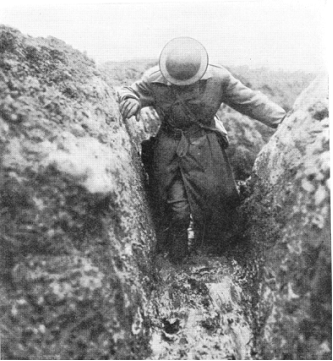
Capt. ___ was a most conscientious officer but was rather small and not very powerful physically. On one occasion he was making his way to the front line with a small squad of men. The latter struggled through the sticky mud of the communication trench but not being strong enough for this Capt. ___ made his way along the top of the trench. While this was easier than through the trench he nevertheless got bogged down to the point of not being able to move forward. His difficulty was contributed to by the fact he was wearing thigh high gumboots. His men in the trench waiting for him heard him addressing himself “Capt. ___ the colonel insists that you report to him without further delay.” He then answered “Yes Colonel I am on my way and will report to you at the earliest possible moment.” He repeated this supposed command by his colonel and his reply several times after which one of his men climbed from the trench and suggested to him that if he discarded his gumboots and didn’t worry about getting his feet wet he’d be able to move on. This suggestion got him out of trouble and eventually up to the front line.
FELLED TREES AS AN INFANTRY OBSTACLE
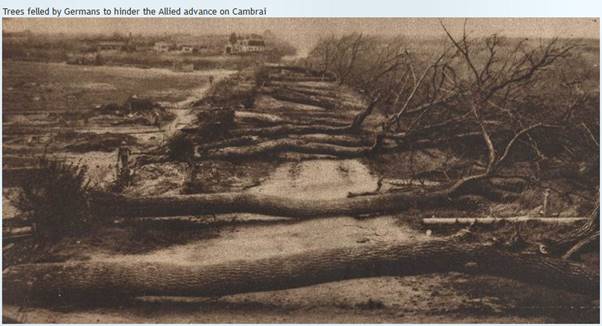
I experienced this type of obstacle only once on the outskirts of Louverval village. In a small wood, the trees, most of them of 2 feet diameter, had been sawn three-quarters through about 2 feet 6 inches above ground and then felled so that their branches faced West. A small patrol could have worked its way slowly through this obstacle by climbing through the branches and/or crawling under the horizontal trunks, but an attacking company or other similar unit would be hopelessly demoralised and slowed up. Therefore our attack in this area had to work round the wood on either side and troops were then an easy mark for German machine guns specially sited to deal with such an attack. We then had the job of silencing these machine guns, which in due course we did, before we could go further forward. The felled trees obstacle was extremely effective.
BOX BARRAGE
This is very effective if laid down by overwhelming artillery fire which either smashes everything in its way or forces enemy troops to take cover in pill boxes or dugouts from which they can be easily winkled out by advancing troops. The disadvantage of the “box” is that no artillery fire can be so accurate that a percentage of descending shells will not fall short and so catch some of the attacking troops. This I have seen happen and count myself lucky that I was not one of the casualties. Also the barrage is so thick that exploding shells and the soil hurled into the air by them make very difficult the keeping of direction and maintenance of times laid down for achievement of stated objectives.
PROJECTED ATTACK ON BUTTE-DE-WARLENCOURT
The Butte, standing up in a sea of mud, was about 500 yards in front of our line. Our orders were to attack from our front trench at dawn on the specified day. Came the day and the attack was deferred because of the virtual impossibility of troops negotiating the quagmire in front of them. The attack was reinstated for the following day but again deferred. This deferment and reinstatement went on day after day for a week or more until the staff finally called the projected attack off. The particularly exasperating feature of the business was that the deferment order each day only came through a few minutes prior to the set time for attack commencement. Had the deferment order not reached us in time and we had left our trench in an attack we would have been in real trouble.
TROOP MOVEMENTS BY BUS
When we had to use buses to take us to new locations from existing billets we sometimes experienced the seeming absurdity of being marched several miles to an embussing point only to find that the bus route was through the billeting area we had vacated. Understandable of course when one realises the buses had to pick up various battalions and other units billeted throughout a largish area. Sometimes the staff are not the dopes the average infantryman thinks them.
MILITARY AWARDS
These undoubtedly serve the purpose of recognising and rewarding genuine deeds of valour in action and high quality organisation, administration and planning by personnel not in action. However, I think there could be a case for differenting (differentiating) the awards in appearance for the two types of soldiers. A particularly bad feature of the awards system is the deplorable policy of issuing a percentage of awards on a quota basis. At one stage of my service I was temporarily attached to a Brigade Staff, and after a particular action, one of the battalions failed to submit an awards recommendation because it was considered there had been no justification for such a recommendation. Division’s reaction was to instruct the battalion (through Bde.) to recommend a stated number of different classes of awards. This policy obviously cheapens genuine awards. I was personally awarded an M.C. and Bar and was “Mentioned in Despatches” on three occasions. In view of questionable awards policies - makes one wonder!
CONCLUSION
The foregoing notes are disjointed and fragmentary, mainly the result of a faulty memory and failure to keep any written record of my experiences – the latter failure stemming, I fear, from congenital laziness.
One of the subalterns in my battalion (the 56th) Lt. H. R. Williams, wrote a book “The Gallant Company”. This was “A” Coy 56th Bn. which Dick Williams joined Feb 1916.
His introductory note to this book reads:-
“On active service I kept a diary. On my return to Australia many letters which I had written during the war came again into my possession . From these resources I have compiled this story of war time life in the Australian Imperial Force. My gratitude is due for much kindly advice from Dr. Gordon Tait and Major W.J.R. Scott D.S.O. and for valuable assistance in revising the manuscript to Mr. F.M. Cutlack.” H.R. Williams
Because of his evident dedication as a diarist and letter writer his book gives voluminous details of his experiences and those of many of his mates in “A” Company. Mr Liddle might find in the book material relevant to his researches. If he does not have a copy of “The Gallant Company” I would gladly pass to him my copy if he thinks it might be of use to him.
FAMILY INVOLVEMENT
When I enlisted I thought my three brothers, all older than I, would necessarily have to stay home to look after the family - but did they? By gosh no! They were into the mess pronto with nary an apology to me! Sergeant Herbert was killed in an attack on the Hindenburg Line, Major Vivian M.C. and Bar rode the war out, Lieut. Percy acquired an M.C. plus disabling chest and rheumatic troubles and I managed to make my way through to the Armistice after which I was granted Long Service Leave, which I could take either as 75 days in UK or six months in Australia. I chose the latter as I felt confident that at the end of the leave I would receive my discharge from the Army, which in fact I did thus saving myself the frustration of a long wait for a troopship to bring me back home if I remained with the Army in France or UK.
PROMOTION DETAILS – V.E. SMYTHE
Egypt } Lance Cpl.
} Cpl.
} Sergeant
Gallipoli } 2nd Lieut.
} Lieut.
Belgium } Captain 2 i/c “B” Co. 56th Bn
France } O.C. “A” Co. 56th Bn. on death of previous O.C. Capt. Fred Fanning
NEXT >>